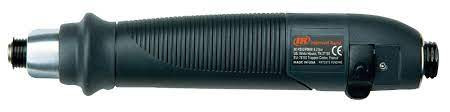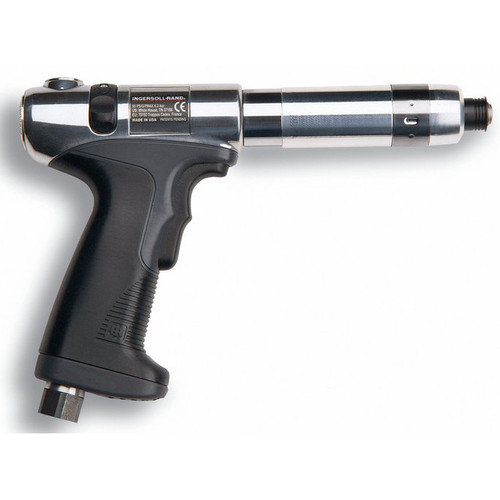



For repetitive fastening operations that require faster screw rundown with deliberate operator-controlled activation, the Ingersoll Rand QP1S20S1TD Pneumatic Screwdriver combines 2,000 RPM free speed with a 2.7 to 22.1 in-lb torque range and trigger-start operation. This speed and torque combination supports production assembly tasks involving compatible lower-torque fasteners, while trigger activation gives the operator direct control over when each fastening cycle begins.
The Ingersoll Rand QP1S20S1TD is suited to assembly processes where controlled torque delivery and efficient fastener rundown are important to productivity and joint quality. Its 2,000 RPM speed helps reduce rundown time on compatible fasteners, while the adjustable torque range allows output to be matched to different joints within the tool's specified capability. Trigger-start operation is useful when the operator needs to position the bit and tool before intentionally initiating rotation.
Type: Pneumatic Screwdriver | Model: QP1S20S1TD | Free Speed: 2,000 RPM | Torque Range: 2.7 - 22.1 in-lbs | Start Type: Trigger-Start
|
Features:
Made in USA: |
 |

Applications:
- Electronics and electrical equipment assembly — installing compatible screws in enclosures, panels, controls, and related components.
- Appliance manufacturing — fastening housings, brackets, panels, and subassemblies within the specified torque range.
- Automotive component production — tightening compatible lower-torque fasteners on production parts and assemblies.
- General manufacturing — completing repetitive screwdriving tasks where faster rundown and controlled tool activation support the assembly process.
- Production workstations — performing repeated fastening cycles where the operator needs direct trigger control over tool startup.
FAQs:
- Q: What does trigger-start mean on the Ingersoll Rand QP1S20S1TD?
A: Trigger-start means the operator manually activates the screwdriver using its trigger. This allows the bit to be positioned on the fastener before rotation begins. - Q: What torque range does the QP1S20S1TD provide?
A: The specified torque range is 2.7 to 22.1 in-lbs. Select the appropriate setting according to the fastener, joint characteristics, component material, and assembly requirements. - Q: What is the advantage of the 2,000 RPM speed?
A: The higher speed supports faster fastener rundown in compatible lower-torque applications, which can be useful where cycle time is an important production consideration. - Q: How does trigger-start differ from push-to-start operation?
A: Trigger-start requires the operator to manually actuate a trigger to begin rotation. Push-to-start tools begin operating when sufficient axial pressure is applied at the fastener, which can simplify repetitive straight-access fastening cycles. - Q: How should the final fastening torque be verified?
A: Adjust the screwdriver within its specified torque range according to the assembly requirements, then verify the resulting torque on the actual production joint using the quality-control method required for the process.
Available Variations and Specifications
| Model | Torque Range 1 in-lbs (Nm) |
Torque Range 2 in-lbs (Nm) |
Torque Range 3 in-lbs (Nm) |
RPM | Weight lbs (kg) |
Length in (mm) |
Side to Center in (mm) |
Drive in |
Air Consumption CFM (L/min) |
|---|---|---|---|---|---|---|---|---|---|
| Trigger Start | |||||||||
| QP1S20S1D | 2.7–9.7 (0.3–1.1) | 8.0–22.1 (0.9–2.5) | — | 2,000 | 1.9 (0.8) | 8.8" (223) | 0.6" (15) | 1/4" | 16 (450) |
| QP1S20S1TD* | 2.7–9.7 (0.3–1.1) | 8.0–22.1 (0.9–2.5) | — | 2,000 | 1.9 (0.8) | 8.8" (223) | 0.6" (15) | 1/4" | 16 (450) |
| QP1S10S1D | 2.7–9.7 (0.3–1.1) | 8.0–27.3 (0.9–3.1) | 13.3–39.8 (1.5–4.5) | 1,000 | 1.9 (0.8) | 8.8" (223) | 0.6" (15) | 1/4" | 16 (450) |
| QP1S10S1TD* | 2.7–9.7 (0.3–1.1) | 8.0–27.3 (0.9–3.1) | 13.3–39.8 (1.5–4.5) | 1,000 | 1.9 (0.8) | 8.8" (223) | 0.6" (15) | 1/4" | 16 (450) |
| QP1S05S1D | 2.7–9.7 (0.3–1.1) | 8.0–28.3 (0.9–3.2) | 13.3–47.8 (1.5–5.4) | 500 | 1.9 (0.8) | 8.8" (223) | 0.6" (15) | 1/4" | 16 (450) |
| QP1S05S1TD* | 2.7–9.7 (0.3–1.1) | 8.0–28.3 (0.9–3.2) | 13.3–47.8 (1.5–5.4) | 500 | 1.9 (0.8) | 8.8" (223) | 0.6" (15) | 1/4" | 16 (450) |
| QP1S02S1TD* | 2.7–9.7 (0.3–1.1) | 8.0–28.3 (0.9–3.2) | 13.3–47.8 (1.5–5.4) | 250 | 1.9 (0.8) | 8.8" (223) | 0.6" (15) | 1/4" | 16 (450) |
| Trigger + Push-to-Start | |||||||||
| QP1T20S1D | 2.7–9.7 (0.3–1.1) | 8.0–22.1 (0.9–2.5) | — | 2,000 | 1.9 (0.8) | 8.8" (223) | 0.6" (15) | 1/4" | 16 (450) |
| QP1T20S1TD* | 2.7–9.7 (0.3–1.1) | 8.0–22.1 (0.9–2.5) | — | 2,000 | 1.9 (0.8) | 8.8" (223) | 0.6" (15) | 1/4" | 16 (450) |
| QP1T10S1D | 2.7–9.7 (0.3–1.1) | 8.0–27.3 (0.9–3.1) | 13.3–39.8 (1.5–4.5) | 1,000 | 1.9 (0.8) | 8.8" (223) | 0.6" (15) | 1/4" | 16 (450) |
| QP1T10S1TD* | 2.7–9.7 (0.3–1.1) | 8.0–27.3 (0.9–3.1) | 13.3–39.8 (1.5–4.5) | 1,000 | 1.9 (0.8) | 8.8" (223) | 0.6" (15) | 1/4" | 16 (450) |
| QP1T10S3D | 2.7–9.7 (0.3–1.1) | 8.0–27.3 (0.9–3.1) | 13.3–39.8 (1.5–4.5) | 1,000 | 1.9 (0.8) | 8.8" (223) | 0.6" (15) | 1/4" | 16 (450) |
| QP1T05S1D | 2.7–9.7 (0.3–1.1) | 8.0–28.3 (0.9–3.2) | 13.3–47.8 (1.5–5.4) | 500 | 1.9 (0.8) | 8.8" (223) | 0.6" (15) | 1/4" | 16 (450) |
| QP1T05S1TD* | 2.7–9.7 (0.3–1.1) | 8.0–28.3 (0.9–3.2) | 13.3–47.8 (1.5–5.4) | 500 | 1.9 (0.8) | 8.8" (223) | 0.6" (15) | 1/4" | 16 (450) |
| QP1T05S3D | 2.7–9.7 (0.3–1.1) | 8.0–28.3 (0.9–3.2) | 13.3–47.8 (1.5–5.4) | 500 | 1.9 (0.8) | 8.8" (223) | 0.6" (15) | 1/4" | 16 (450) |
| QP1T02S1D | 2.7–9.7 (0.3–1.1) | 8.0–28.3 (0.9–3.2) | 13.3–47.8 (1.5–5.4) | 250 | 1.9 (0.8) | 8.8" (223) | 0.6" (15) | 1/4" | 16 (450) |
| QP1T02S1TD* | 2.7–9.7 (0.3–1.1) | 8.0–28.3 (0.9–3.2) | 13.3–47.8 (1.5–5.4) | 250 | 1.9 (0.8) | 8.8" (223) | 0.6" (15) | 1/4" | 16 (450) |
 Looking for more information about the Ingersoll Rand Screwdriver? Click here to view the Catalog
For help choosing the correct Ingersoll Rand Screwdrivers for your application, please call (800) 608-5210 or email info@intlairtool.com
warning WARNING: This or other products sold on this website may expose you to chemicals known to the State of California to cause cancer and birth defects or other reproductive harm.
For more information go to www.P65Warnings.ca.gov